
For nearly four centuries, Britain was part of the vast Roman Empire, linked by roads, law, and culture. Yet empires rarely last forever. By the early 5th century, Roman Britain faced political instability, economic strain, and mounting invasions, ultimately leading to the Romans’ withdrawal and the beginning of a new, tumultuous chapter in English history.
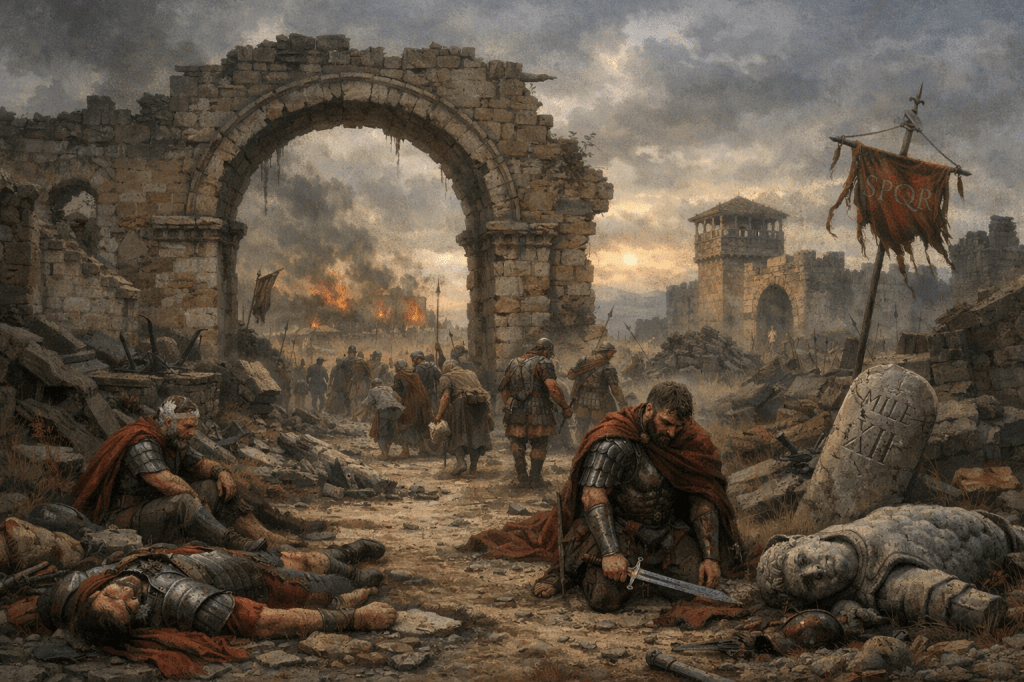
By the late 4th century, the Roman Empire was stretching thin. Britain, at the very edge of the empire, suffered from:
- Military pressures: Germanic tribes like the Angles, Saxons, and Jutes raided the coasts, while northern tribes beyond Hadrian’s Wall occasionally launched incursions.
- Political instability: Rome’s central authority was preoccupied with defending Italy and Gaul. Britain often had to rely on local commanders, eroding centralized control.
- Economic strain: Coins became scarce, trade networks faltered, and local agriculture struggled to support towns and armies.
Even the once-mighty Roman forts along Hadrian’s Wall became difficult to maintain.
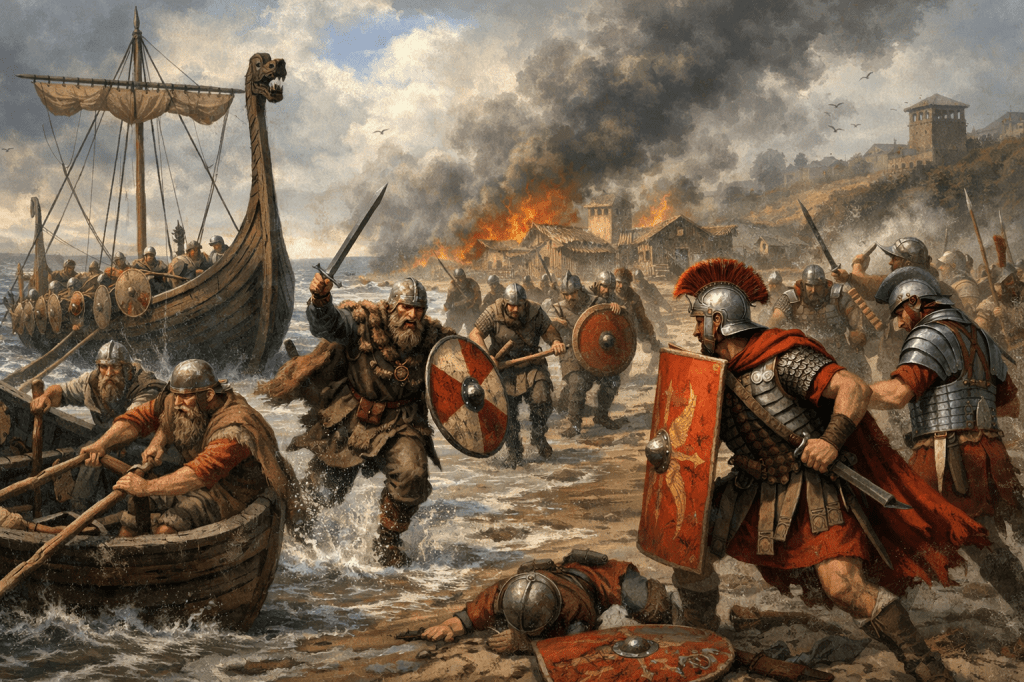
In 410 AD, the emperor Honorius sent a famous letter to the cities of Britain, telling them to “look to their own defense.” Essentially, Rome had abandoned the island.
This withdrawal didn’t happen overnight, but it marked the end of formal Roman administration. Roman governors, soldiers, and officials left, taking with them the political and economic infrastructure that had bound Britain together.
The departure of Rome plunged Britain into uncertainty and fragmentation:
- Local rulers—former tribal chiefs or Romanized leaders—tried to maintain order.
- Germanic migrations began in earnest. The Angles, Saxons, and Jutes settled in eastern and southern Britain.
- Towns and villas gradually declined; rural life became dominant.
This period of chaos is often called the “Sub-Roman” era, a time when the memory of Rome mixed with Celtic traditions, creating the cultural soil from which medieval England—and its literature—would grow.
Although written records are sparse, the mix of Roman, Celtic, and Germanic cultures during the decline of Roman Britain had lasting literary consequences:
- Oral storytelling thrived: With Roman literacy gone from daily life, tales of heroes, battles, and magic were preserved orally. These stories would evolve into the epics of Anglo-Saxon England, like Beowulf.
- Christianity survived: Missionaries and monasteries maintained Latin literacy and preserved texts, bridging the classical world and the medieval imagination.
- Legendary material emerged: The political chaos and cultural memory of Romano-British leaders set the stage for Arthurian legends, which blended historical kernels with myth.
Essentially, the collapse of Roman authority created the conditions for a new kind of literature: one deeply intertwined with oral tradition, heroism, and moral storytelling.
The decline of Roman Britain wasn’t just political—it reshaped culture, language, and literature. From the ruins of Roman towns to the forests of the Celtic hinterlands, the stories of ordinary people, warriors, and early Christians were passed down orally. These narratives became the lifeblood of early English literature, influencing epic poetry, legends, and later medieval chronicles.
In the next article, we’ll explore the emergence of Anglo-Saxon England, the formation of its kingdoms, and the birth of Old English literature, including heroic poetry like Beowulf. This is the period where the foundation for medieval English storytelling truly takes shape.

 Honey & Prose 🍯🌸
Leave a comment