
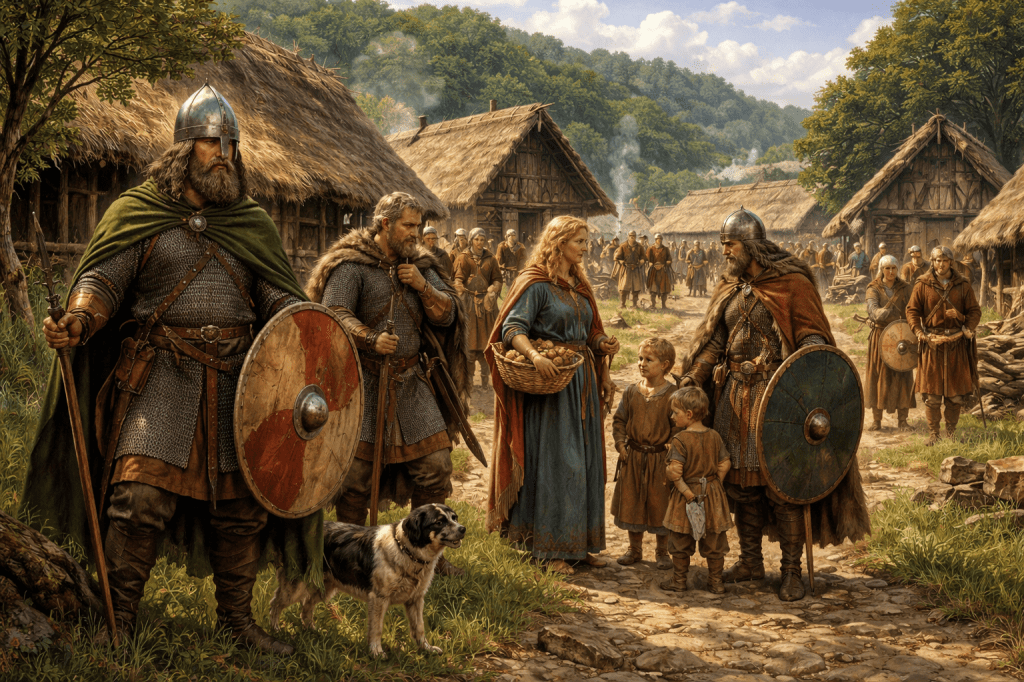
Before we get to pilgrims and playful storytelling with Geoffrey Chaucer, we have to go back much further, to a time that feels almost unrecognizable.
When the Romans left Britain in the early 5th century, they did not make a dramatic exit. There was no grand farewell, no final speech, no sense of closure.
They simply… withdrew.
And what they left behind was not a nation, but a question.
For nearly four centuries, Roman rule had imposed a kind of order on Britain. Roads had been built, towns had grown, and Latin had shaped administration and culture. When that structure disappeared, so did the stability that came with it. What followed was not immediate collapse, but a slow unravelling.
Local leaders tried to hold things together. Some Romano British communities carried on as best they could, holding onto fragments of Roman life. But without the empire’s support, Britain became vulnerable. Raids increased. Pressure grew from outside.
And then, across the North Sea, new groups began to arrive.
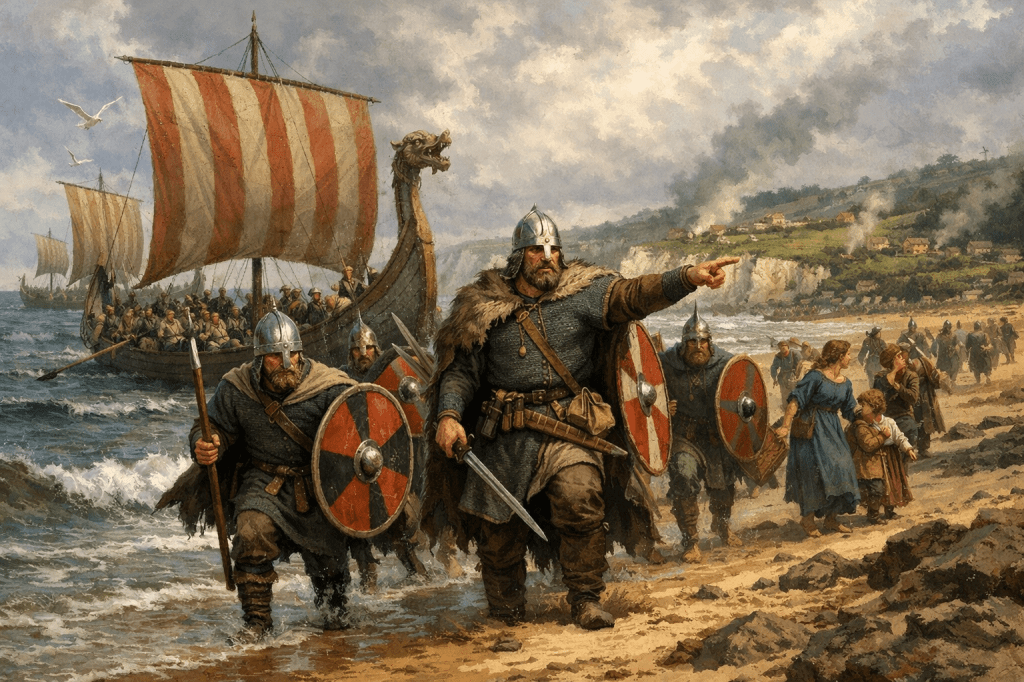
The Angles, Saxons, and Jutes did not arrive all at once, and they did not arrive as a single united force. They came gradually, in waves, as migrants, warriors, and settlers.
Over time, they began to carve out territory.
This was not a peaceful transition. It was a period of conflict, displacement, and uncertainty. The older Romano British culture did not simply blend smoothly with the newcomers. In many areas, it was pushed aside or replaced.
What emerged over the next two centuries was a very different landscape. Instead of a Roman province, Britain became a patchwork of small kingdoms. Among the most important were Wessex, Mercia, Northumbria, and East Anglia.
Each kingdom had its own rulers, its own ambitions, and its own rivalries. Alliances shifted constantly. Power was never secure for long.
This is sometimes called the Heptarchy, though in reality the number of kingdoms was never fixed or neat. What matters is that there was no single England yet, only competing centers of power slowly shaping what England would become.
In this world, loyalty was everything.
Society was built around the bond between a lord and his warriors. A king provided protection, land, and treasure. In return, his warriors offered absolute loyalty, even to the point of death.
This relationship was not just political. It was deeply personal. To fail one’s lord was not only a betrayal, it was a loss of identity.
This idea sits at the heart of Anglo Saxon literature.
Stories from this period are not only about events. They are about values. Courage, loyalty, reputation, and the desire to be remembered matter more than comfort or even survival.
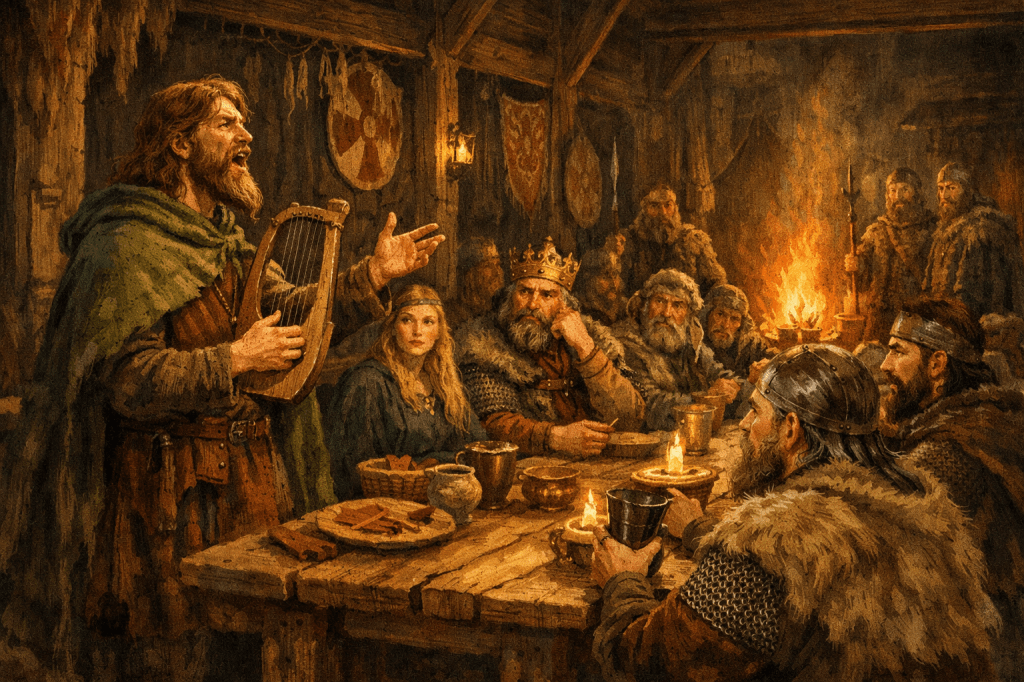
Before writing became common, stories lived in memory.
A poet, or scop, would stand in a hall and recite tales that had been passed down for generations. These were not quiet readings. They were performances. The rhythm of the language, the repetition of phrases, and the structure of the verse all helped both the speaker and the audience remember.
Out of this oral tradition comes one of the most important works in early English literature, Beowulf.
Although it was written down later, the story itself belongs to this earlier world. It reflects the values of a warrior society, where honour and reputation define a person’s worth.
But even in its celebration of heroism, there is something else present. A sense that all victories are temporary. That time eventually defeats everyone.
Anglo Saxon culture placed a strong emphasis on fate, often referred to as wyrd.
Fate was not something you could escape. It was something you faced.
This belief created a particular kind of hero. Not someone who expects to live forever, but someone who acts bravely despite knowing that death is inevitable.
This is why their stories feel both strong and strangely melancholic. There is pride in courage, but also an awareness that everything passes.
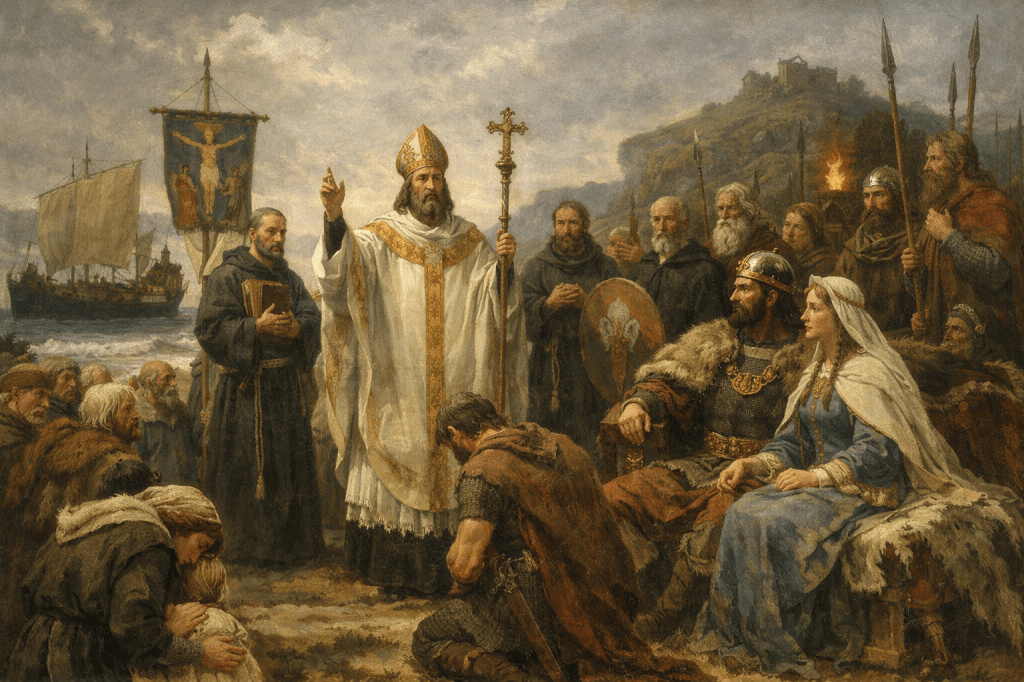
In the late 6th century, another transformation began.
Missionaries arrived from Rome, most notably under the direction of Pope Gregory I, who sent Augustine of Canterbury to convert the Anglo Saxons.
Christianity did not spread overnight. It moved gradually, often beginning with kings and then extending to their people.
What is remarkable is not just that Christianity took hold, but how it interacted with existing beliefs.
The older pagan values did not disappear immediately. Instead, they coexisted with the new religion. Over time, literature began to reflect both traditions.
You see this clearly in Beowulf. The story contains elements of a pagan heroic world, but it is told from a perspective that is aware of Christian ideas.
This blending created a richer, more complex literary voice.
As Christianity spread, so did literacy.
Monasteries became centers of learning. Monks began to write down texts that had previously existed only in oral form. This is how works like Beowulf survived at all.
One of the most important figures in this process was Alfred the Great in the 9th century.
At a time when Viking invasions threatened much of England, Alfred did more than defend his kingdom. He actively promoted education and translation. He encouraged the use of English, rather than Latin, for important texts so that more people could access knowledge.
This decision had long term consequences. It helped establish English as a language of literature and learning.
Just as Anglo Saxon kingdoms were becoming more established, a new threat appeared.
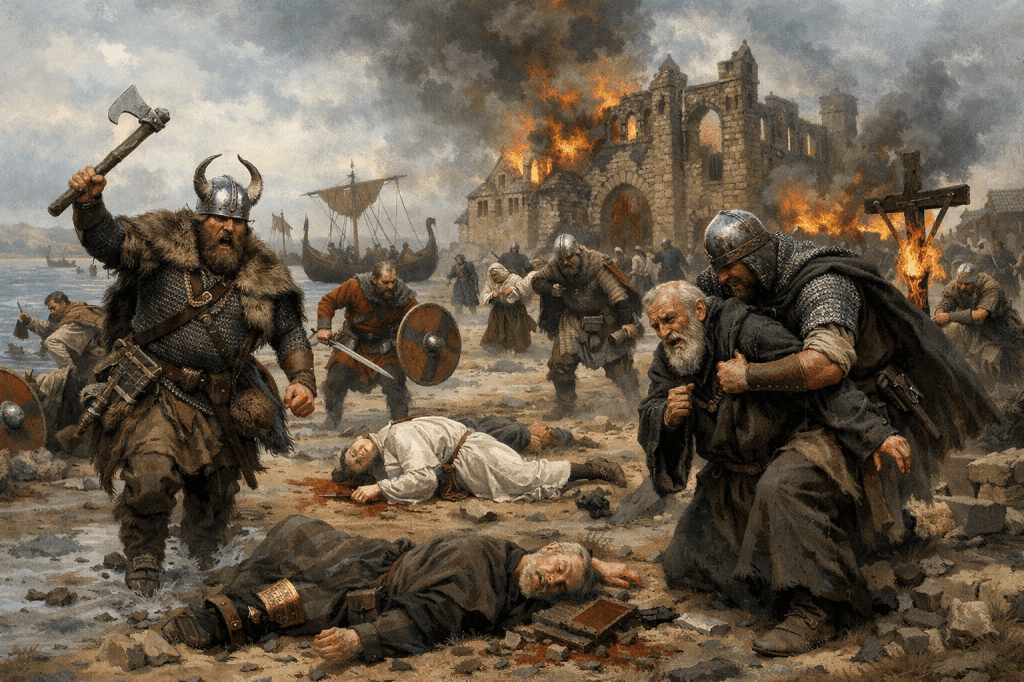
From the late 8th century onwards, Viking raids began to strike the coasts of Britain. At first, these were quick attacks on monasteries and settlements. Over time, they became larger invasions.
Entire regions came under Viking control, especially in the north and east. This area became known as the Danelaw.
The struggle between Anglo Saxon kingdoms and Viking forces shaped the next phase of English history. It forced kingdoms to unify, to strengthen, and to define themselves more clearly.
Figures like Alfred the Great became central not only as rulers, but as symbols of resistance and continuity.
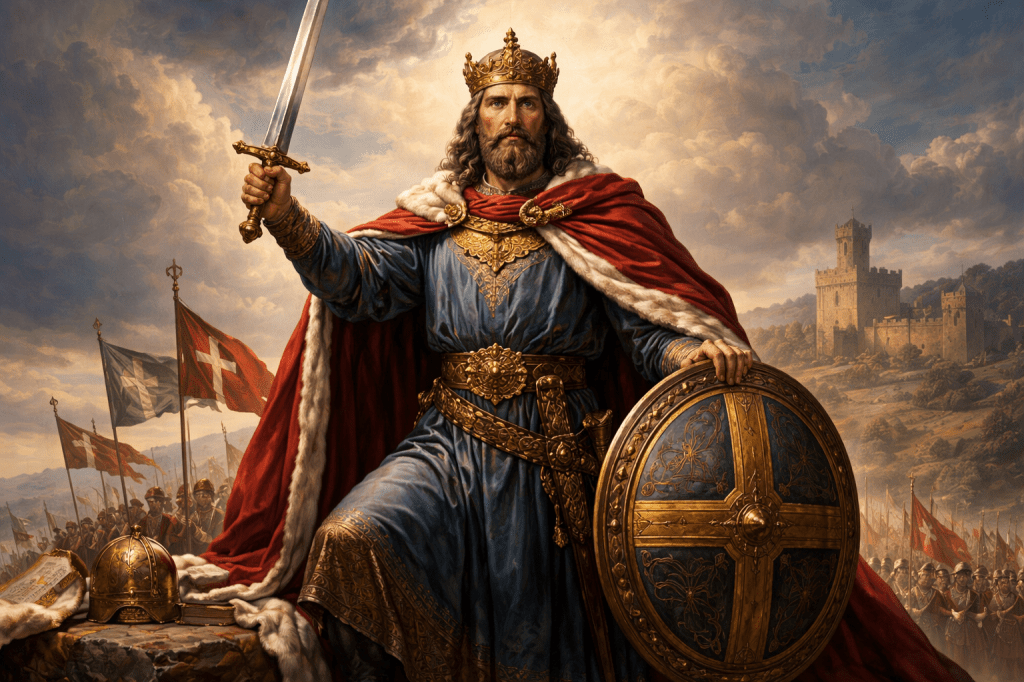
By the 10th century, the idea of a more unified England began to take shape.
Kings of Wessex gradually extended their control over other regions. The concept of one kingdom, rather than many, started to become real.
This did not mean stability. Power was still contested, and succession was often uncertain. But the direction was changing.
England was no longer just a collection of competing kingdoms. It was becoming something more cohesive.
After the time of Alfred the Great, the slow idea of unity began to take a clearer shape, and it is with Athelstan that we can finally speak of something close to a single English kingdom.
Athelstan, Alfred’s grandson, did not simply inherit power, he extended it. In 927, he took control of Northumbria, bringing together lands that had long been divided between Anglo Saxon and Viking rule.
For the first time, a king ruled over what could meaningfully be called all of England. But what makes Athelstan especially significant is not only his military success. His court became a center of learning and culture, attracting scholars and shaping a sense of identity that went beyond individual kingdoms. Under him, the idea of “England” was no longer just geography or ambition. It began to feel like something real, something that could endure.

 Honey & Prose 🍯🌸
Leave a comment