
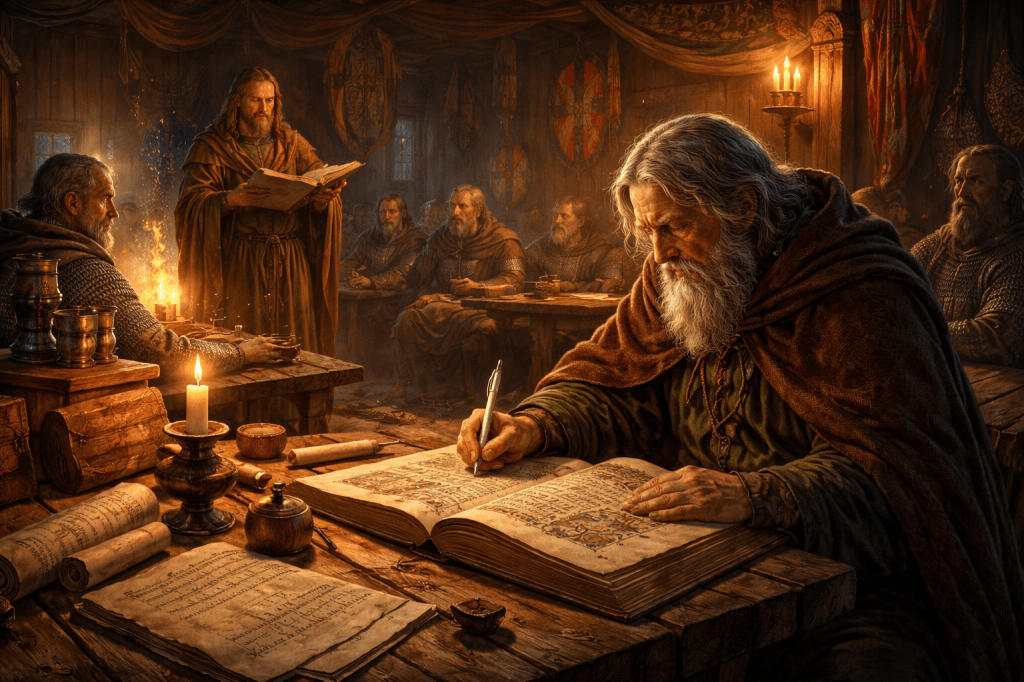
In our previous we spoke about England under the first king to call himself “King of the English People”: Athelstan. For the first time, the word “England” had real meaning.
But Athelstan’s greatness was not only military. His court became a beacon of culture and scholarship. Manuscripts were collected, laws codified, and scholars drawn from across Europe sought to be part of his court. He nurtured the sense that England was more than just a collection of kingdoms—it was a place with an identity, history, and purpose. Under Athelstan, the idea of a single English nation began to live and breathe.
Even after Athelstan’s success, England could never rest. The 10th century was still a time of Viking pressure. Raids continued, and settlements established by Danes in the northeast and east, known as the Danelaw, kept the threat alive. The balance between Anglo-Saxons and Vikings shaped the politics of the time.
Kings like Edmund, Edgar, and later Æthelred the Unready struggled to maintain authority over a country still patchworked by loyalties, local leaders, and external threats. The constant tension between the need for unity and the reality of division gave Anglo-Saxon governance a mix of pragmatism and creativity. It also reinforced the values celebrated in literature: courage, loyalty, and the fragility of human life.
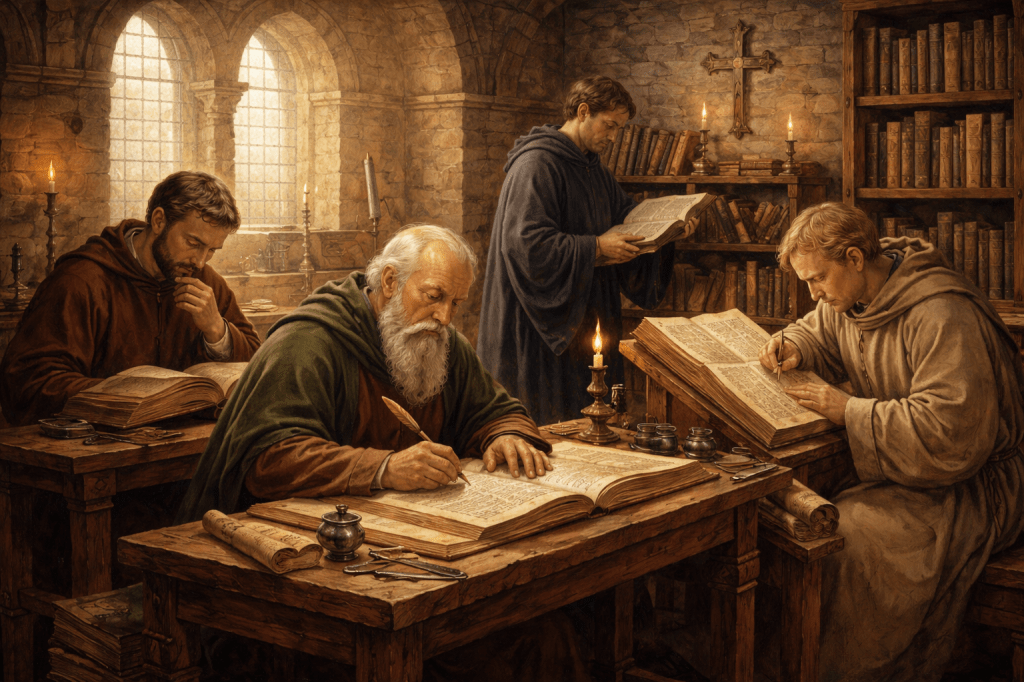
While kings fought wars and managed threats, monasteries and courts preserved knowledge. Scholars collected both Latin and Old English texts. Chronicles recorded battles and royal deeds, poetry celebrated heroism, and religious texts offered moral reflection.
By this period, the oral traditions were increasingly written down. Beowulf, although composed earlier, was preserved in manuscripts, while other poems, homilies, and chronicles expanded the record of Anglo-Saxon life. Literature became both a reflection of life in an uncertain world and a way to assert cultural identity—especially in times of upheaval.
The late 10th and early 11th centuries were turbulent. King Æthelred the Unready faced renewed Danish invasions, leading to a period of conflict that culminated with the reign of Canute, a Danish ruler who successfully held the English throne. Canute’s reign, while foreign in origin, was surprisingly stabilizing. He maintained existing Anglo-Saxon institutions, showing that the values of the old order could survive even under new rulers.
After Canute, the throne went to Harthacnut. Harthacnut’s reign was short and troubled, partly because he was also king of Denmark and faced unrest in England. That period of instability after his death is what made Edward’s succession a pivotal moment before 1066.
Edward the Confessor, the son of Æthelred, inherited a kingdom in relative peace but with unresolved tensions. His long absence in Normandy exposed England to foreign influence and laid the stage for claims by Norman and Scandinavian nobles alike.
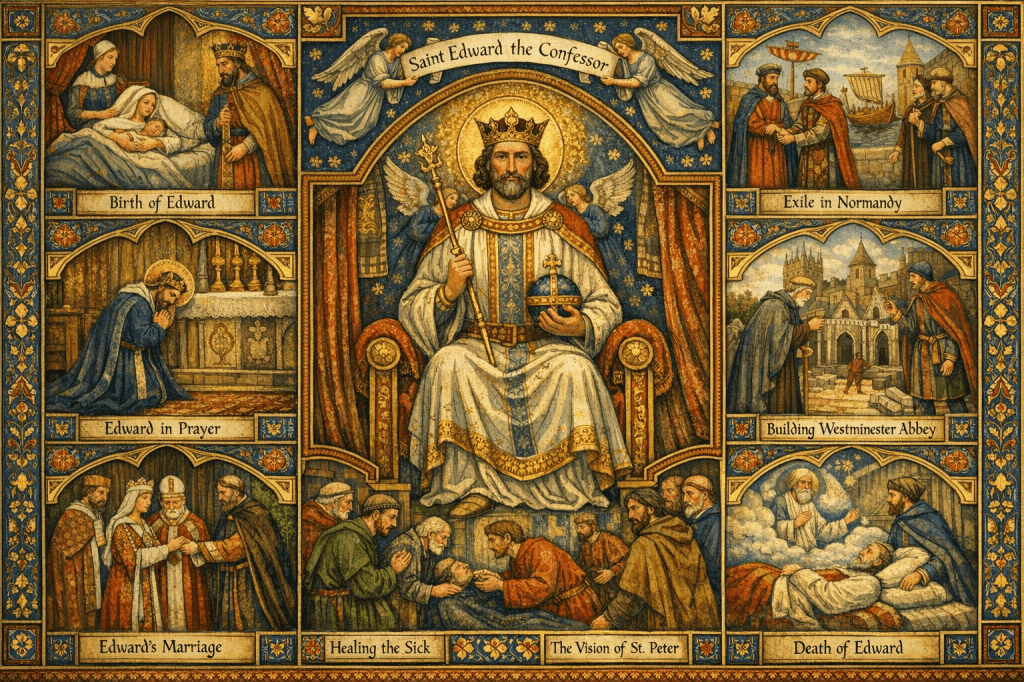
Edward the confessor was famously celibate. Therefore, he didn’t leave a male heir to secure the kingdom after his death. During his lifetime he was well aware of this problem, and tried to manage the possible civil war that would occur after his death by appointing the next heir to the throne and securing the support of the nobles. To the much dismay of the English nobility, he names William the Bastard of Normandy as his successor.
It could be due to the fact that Edward spent much of his life in exile in Normandy. As distant cousins, we can deduce that they must have spent much of their childhood together and formed a strong alliance and kinship during that time. Edward was almost thrusted upon the English throne without much preparation. He would have definitely found the English court alien and felt like an outsider.
We can all but speculate to his true intentions but in any case, this decision didn’t sit well with the English nobility, especially Earl Godwin who in recent years have rose to much power and influence in the English court. He was a prominent member of the English nobility by this time.
Edward’s death in January 1066 triggered a crisis. Multiple claimants claimed the throne, including Harold Godwinson, William of Normandy, and Harald Hardrada of Norway.
In the power vacuum that followed, Harold was crowned king almost immediately.
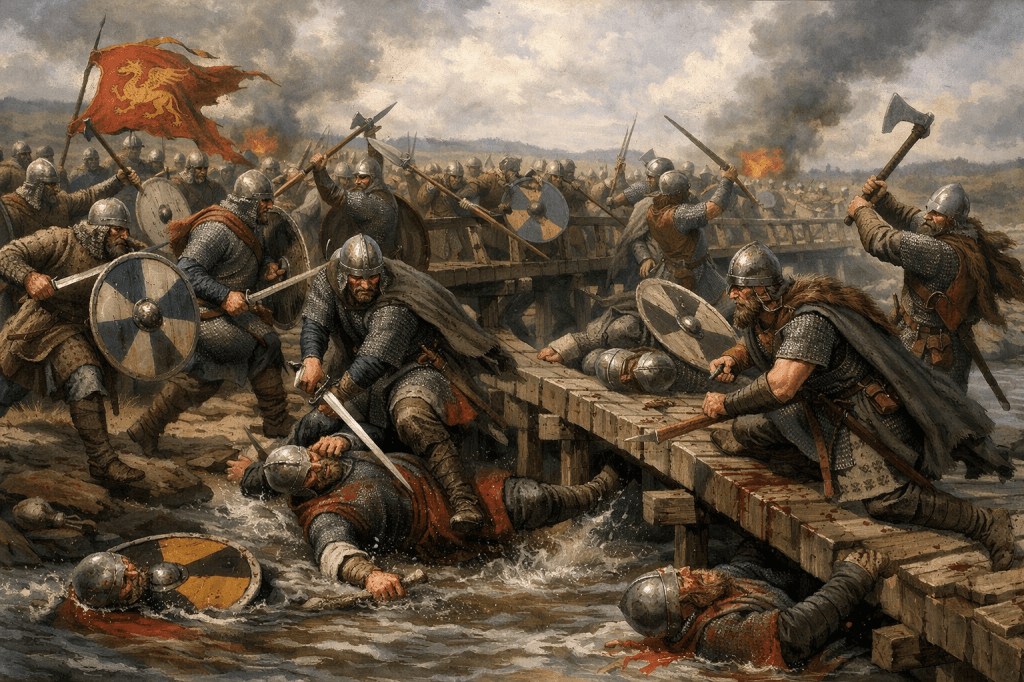
Harold had little time to consolidate his rule. In September 1066, he faced an invasion from the north. Harald Hardrada, allied with Harold’s own estranged brother Tostig, landed in Yorkshire. At the Battle of Stamford Bridge, Harold’s army marched north and defeated the invaders, killing Hardrada. It was a remarkable victory, but it left Harold’s forces exhausted.
Almost immediately, news arrived that William had landed on the southern coast of England, near Pevensey. Harold had to march his army south again, covering nearly 200 miles in less than two weeks. The exhaustion of Harold’s troops would prove decisive.
On October 14, 1066, the two armies met at Hastings. Harold’s forces formed a shield wall on the hill, a classic Anglo-Saxon defensive strategy. For hours, the battle was evenly matched. The English held firm against repeated Norman assaults.
But William’s army was innovative. The Normans used cavalry, archers, and feigned retreats to break the shield wall. In the chaos, Harold was killed—legend says an arrow struck him in the eye. With their king dead, the Anglo-Saxon army disintegrated.
William emerged victorious. That single day changed England forever.
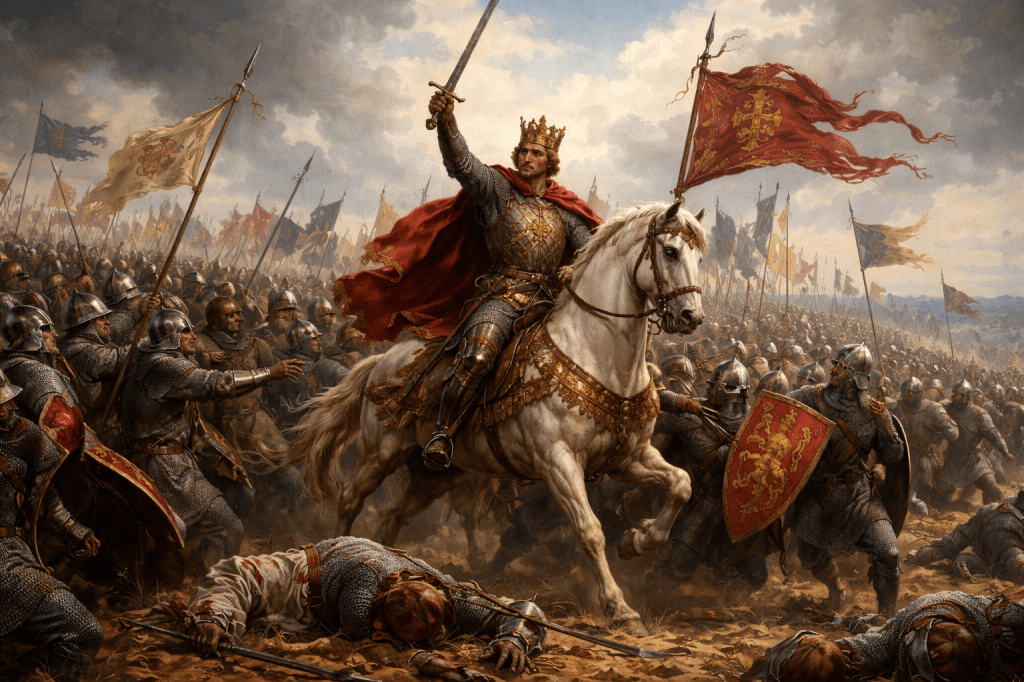
William did not just win a battle; he won a country. Over the next few years, he systematically replaced the Anglo-Saxon elite with Norman nobles, redistributing land and consolidating power. Castles were built across the landscape, both as military fortresses and symbols of Norman authority.
The English language began to change rapidly. French became the language of the court, law, and high culture, while Old English continued among the common people. This linguistic and cultural blending would eventually give rise to Middle English and the literary flowering that Chaucer would later represent.
The Normans also reshaped governance. They centralized authority, established new taxation systems, and strengthened ties to continental Europe. The political and cultural upheaval was immense, but the foundations laid by the Anglo-Saxons—monarchs like Alfred, Athelstan, and Edward, the literary and oral traditions, the laws, and the social structures—remained deeply embedded.
The Norman Conquest marked the end of Anglo-Saxon rule, but it did not erase Anglo-Saxon culture entirely. Their language, laws, literature, and values survived in new forms. Many chroniclers, such as the Anglo-Saxon Chronicle, continued to preserve the memory of England before 1066.
By the time of Chaucer, England had become a nation shaped by centuries of Anglo-Saxon resilience and the dramatic shock of Norman conquest. The old stories of warriors, kings, and fate were still alive, mingling with new influences and preparing the soil for a literature that could laugh, reflect, and dream on an entirely new scale.

 Honey & Prose 🍯🌸
Leave a comment