
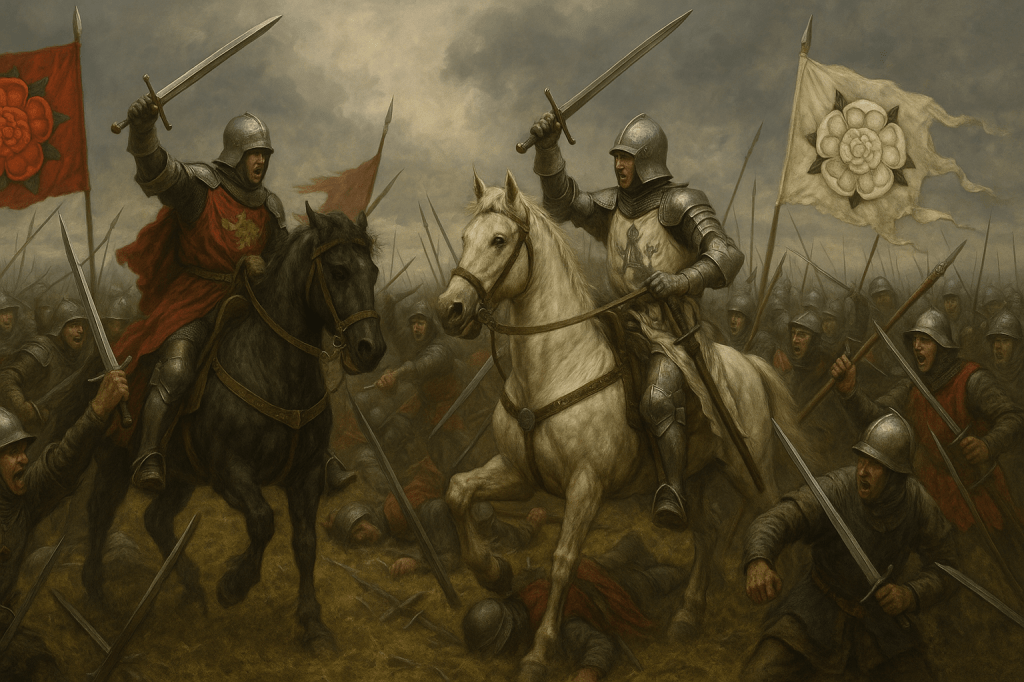
England in the 15th century was a land on edge. After decades of intermittent warfare in France and the unstable reign of Henry VI of England, the kingdom’s nobles were restless, ambitious, and divided. What followed was nearly thirty years of dynastic conflict that would tear England apart: the Wars of the Roses.
The war was named centuries later for the emblems of the rival factions: the red rose of Lancaster and the white rose of York. At its heart, the conflict was about more than symbols. It was a struggle for power, legitimacy, and survival.
Henry VI’s weak leadership and bouts of mental instability left the throne vulnerable. His queen, Margaret of Anjou, became a formidable political actor, determined to protect her son’s inheritance. Across the kingdom, ambitious nobles plotted, rebelled, and shifted alliances like a storm-swept sea.
The Yorkist Challenge
The House of York, claiming a stronger hereditary right, challenged the Lancastrian rule. Leaders like Richard, Duke of York pressed their claims through both politics and military force. Battles such as St Albans (1455) marked the opening of the conflict, a signal that England had entered a period of almost constant warfare.
The nobility and gentry were drawn in, local loyalties split, and England became a chessboard of shifting allegiances. Ordinary people were caught in the turmoil, and entire regions suffered as armies marched, pillaged, and fought across the countryside.
Key moments defined the Wars of the Roses. The Battle of Towton (1461), one of the bloodiest in English history, saw Edward IV of York secure the throne. His triumph was decisive, but fragile.
Edward IV’s reign brought temporary stability, yet rivalries never truly ended. After his death, his brother Richard III seized the throne in controversial circumstances, igniting the final phase of Yorkist-Lancastrian struggle.
The Lancastrians, led by Henry Tudor in exile, continued to press their claims. Henry gathered support in France and Wales, biding his time while the Yorkist rule faltered under Richard III.
The Literary Lens
This period of chaos did not only unfold on battlefields. Chronicles, poetry, and drama reflected the anxieties and fascination of the age. Writers recorded bloodlines, betrayals, and heroic deeds. Stories of honor, fate, and moral consequence central to earlier Anglo-Saxon and Plantagenet literature found renewed urgency.
The turbulence of the Wars of the Roses shaped the imagination of English storytellers, setting the stage for later historical narratives and the rich literature of the early Tudor period. Themes of contested legitimacy, the rise and fall of kings, and the interplay of personal ambition and national destiny echo through the stories of this time.
The End of the Wars
The decisive end came at the Battle of Bosworth Field (1485). Henry Tudor defeated Richard III, who died in battle, and claimed the crown as Henry VII of England. This marked the end of the Plantagenet dynasty and the beginning of the Tudor era.
Legacy of the Wars
The Wars of the Roses were more than a dynastic squabble. They transformed the English monarchy, reshaped noble power, and left a deep imprint on national identity. The conflicts crystallized ideas about legitimacy, loyalty, and governance.
Literature absorbed this intensity. Tales of heroism, tragedy, and moral consequence were rooted in historical reality, bridging the gap between history and imagination. By the time of the early Tudor period, England had emerged with a sharpened sense of its past, ready for a literature that could be both reflective and inventive.

 Honey & Prose 🍯🌸
Leave a comment