

This year, I set myself a simple, steady goal: twenty-six books. Two a month, with a couple of extras saved for summer, when time loosens a bit and I get more time for myself.
For January, I chose two books that could not be more different, yet somehow felt perfectly matched for the way my mind has been moving lately: Pride and Prejudice by Jane Austen, and The Castle by Franz Kafka.
One is a book I know so well it almost feels like part of my internal furniture. The other is a book I had been circling for years. Together, they are going to mark the beginning of a new reading year.
Reading an Old Love with New Eyes
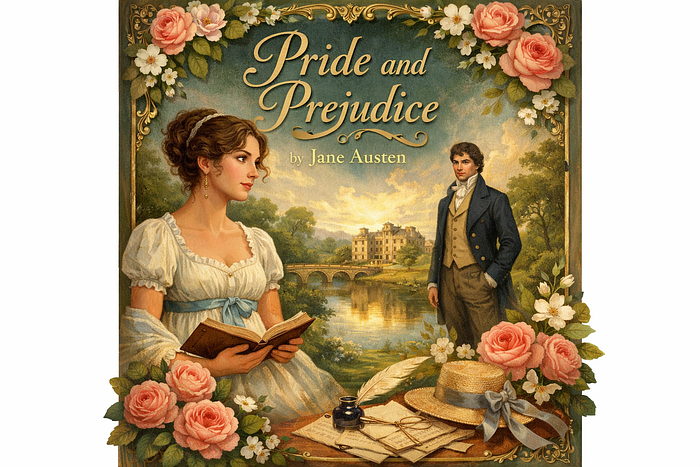
I have read Pride and Prejudice more times than I can reasonably admit. It was one of the first classics I fell in love with, back when love for books was instinctive and uncomplicated. I read it for Elizabeth’s wit, for Darcy’s slow thaw, for the deep satisfaction of knowing everything would end exactly as it should.
For a long time, that was enough.
But somewhere along the way, my reading habits have changed. I’ve been reading English classics since I was about 11 years old. I remember I started with abridged versions because the language was too complex for a child at 11, but later of course I read the full unabridged versions and fell in love with the stories, the characters and started idolizing the authors a little bit too. Jane Austen has always been at the top of the list of Authors I admired the most. I fell in love with her writing, I’ve read all her work, multiple times and still I reach out to her books when I need a pick me up, or when I’m so indecisive of what to read next. I think its safe to say that Austen is one of the authors that inspired me to become a writer. Over the years I have evolved as a reader. I used to read books, be engrossed in the story, the plot and once I’ve finished I’d move on to the next. But now I look at English classics from different angles, as a writer, as a literary scholar. I research, I pause mid-paragraph to look things up, I annotate, I look into what inspired these writers, I question motives. I disagree with authors I once trusted implicitly.
So returning to Austen this time feels different. Not like comfort-reading, but like a conversation resumed after years apart. I’m picking up pride and prejudice after 2 years. Last time I read it, I was a different person. I was sitting outside the Chatsworth House garden in Bakewell, I was feeling rather romantic and every time Darcy was on the page, I looked up at the house and imagined it to be Pemberley, because I’ve heard that Austen got her inspiration for Pemberley from Chatsworth. I’m still a romantic at heart, I always will be, but something has shifted in the past couple of years and I do look at things in a rather different way.
Darcy is so often reduced to a romantic ideal. To me now he reads as someone painfully slow to recognise the extent of his own conditioning. His growth is real, but it is hard-won, and not without damage along the way.
In P&P Austen gives us something enduring: a heroine who learns. Elizabeth revises her judgments. She reflects. She changes her mind. That quiet intellectual humility feels more radical to me now than any grand romantic gesture ever could.
I’m already well into the later chapters of volume 1, and it feels so refreshing this time, reading my most loved novel but as a quite different person to who I was when I last read it.
Stepping into Uncertainty with The Castle

If Austen represents order, The Castle represents everything unresolved.
This will be my first time reading Kafka’s novel, and I’m approaching it with a mix of anticipation and resistance. I know enough about Kafka to know that clarity is not the point. That discomfort is not a flaw, but a feature.
For the longest time, I’ve been procrastinating and postponing when it comes to Kafka, without any good reason to justify my actions.
Kafka has felt rather intimidating to me as a reader, I wasn’t sure if I was ready to do justice to his stories. I felt like I wasn’t emotionally or psychologically ready to delve into his books. You might think I’ve thought way too much about it, but as someone who’s spent my entire life with romanticism when it comes to literature and art, Kafka’s literary style which is realism, Absurdism and Expressionism, felt way more intimidating to me. But Recently I’ve started opening up myself to try more styles, more genres which helped to expand my understanding English literature across the board. I’m glad I waited to read Kafka. If I read him back then, it may have felt like a task, or a chore. But now I know I’m ready to give him my full attention and time.
From what I understand, The Castle is a story about authority that cannot be reached, systems that cannot be understood, and a protagonist who is never fully acknowledged. It is a novel built on delay, confusion, and exhaustion.
There is something fitting about beginning the year this way by placing myself inside a narrative that unsettles rather than comforts. Kafka does not offer escape. He offers immersion. And I’m curious to see what it feels like to sit with that unease instead of trying to resolve it too quickly.
Why These Two, and Why Now
At first glance, these novels could not be more different. One is precise, socially attuned, and meticulously structured. The other is fragmented, oppressive and deliberately opaque.
But that contrast is exactly the point.
Both books are concerned with systems and the individual’s attempt to move within them. One suggests that understanding and adaptation can lead to harmony. The other questions whether understanding is ever possible at all.
January is not about answers. It’s about intention.
By the end of the month, these books will no longer be untouched objects on my shelf. They will have left marks on the pages, and on the way I think.
Feels like the right way to begin my reading goal for the year.

 Honey & Prose 🍯🌸
Leave a comment