
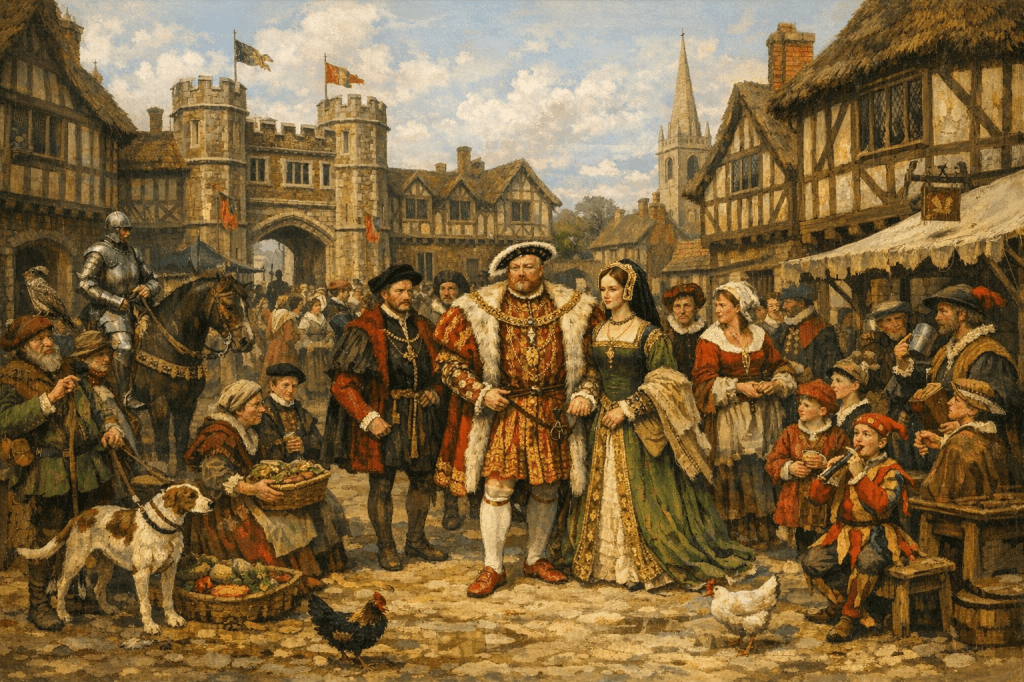
The Tudor story begins at the end of the Wars of the Roses. England had been torn apart by decades of conflict between rival noble houses. When Henry VII took the throne in 1485, his first priority was simple: control.
He reduced the power of the nobility, strengthened the monarchy, and focused heavily on financial stability. His reign does not dazzle with drama, but it matters deeply. It creates the foundation on which everything else is built.
Culturally, England is still looking outward. The Renaissance has already begun in Italy, but England is only just beginning to absorb its ideas. Education expands slowly, and humanist thought starts to take root.
One key figure here is Thomas More, whose work Utopia imagines an ideal society. It reflects a growing curiosity about how the world could be organized differently. That curiosity becomes a defining feature of the age.
Then comes Henry VIII, and everything accelerates.
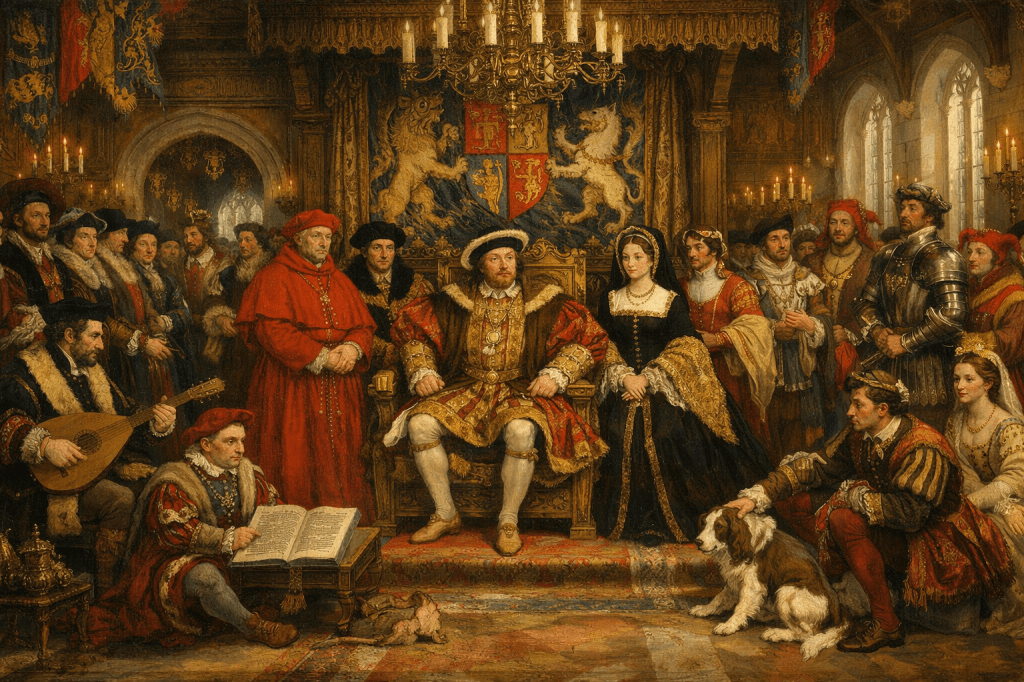
Henry’s reign is often remembered for his six marriages, but the real turning point is political and religious. When the Pope refuses to annul his marriage, Henry breaks from the Catholic Church and establishes the Church of England.
This moment, known as the English Reformation, changes the country permanently.
Monasteries are dissolved. Church lands are redistributed. Religious authority shifts from Rome to the English crown. This is not just a theological change. It reshapes wealth, education, and daily life.
For literature, the effects are enormous.
- Religious texts begin to appear in English rather than Latin.
- Access to reading expands.
- Debate and argument become central to writing.
Figures like William Tyndale play a crucial role by translating the Bible into English, making it accessible to ordinary people. This is both a literary and political act.
At the same time, the court becomes a center of artistic expression. Poetry flourishes, especially through figures like Thomas Wyatt and Henry Howard, Earl of Surrey. They introduce and adapt forms such as the sonnet into English, drawing inspiration from Italian Renaissance writers like Petrarch.
Love, power, and courtly life become central themes. But beneath the elegance, there is tension. Writers must navigate a dangerous political environment where the wrong words can have serious consequences.
Henry’s six marriages are not just personal drama. They are tightly bound to politics, succession, and religion.
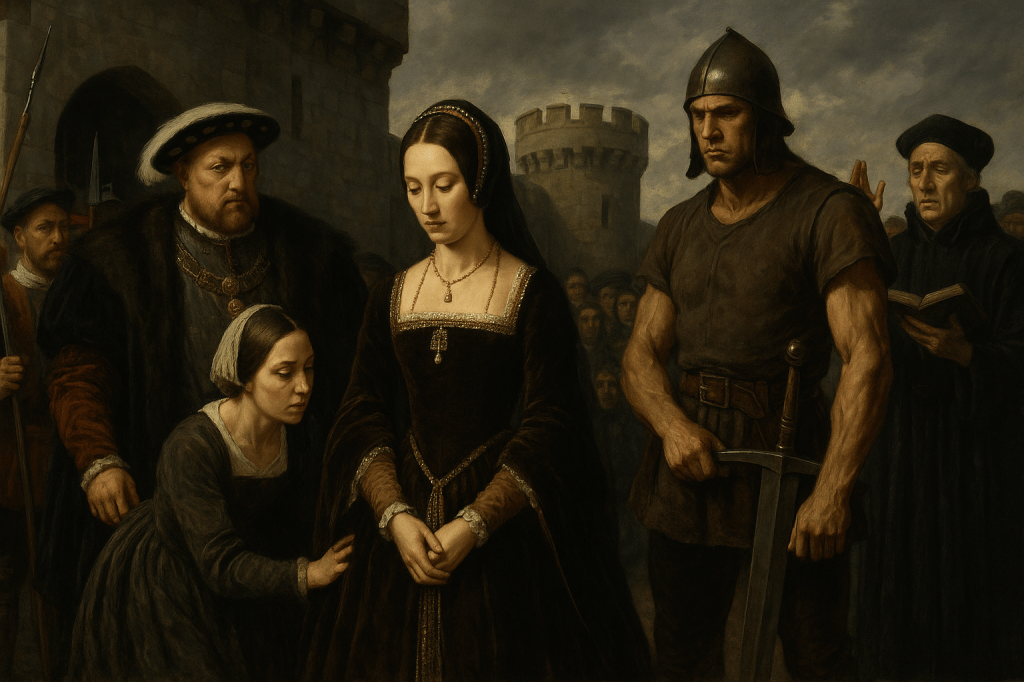
He married Catherine of Aragon, whose failure to produce a male heir led to the break with Rome. Anne Boleyn, who gave birth to Elizabeth, was later executed on charges that remain controversial. Jane Seymour finally bore him a son, Edward, but died soon after. Anne of Cleves was quickly set aside in an annulled marriage. Catherine Howard, young and politically vulnerable, was executed for alleged infidelity. Finally, Catherine Parr survived him and played a role in reconciling his children.
These marriages reflect Henry’s obsession with securing the Tudor line, but they also reveal how dangerous life at court could be, especially for women whose fates were tied to the king’s will.
After Henry’s death, England enters a period of instability.
Under Edward VI, Protestant reforms deepen. Religious texts are standardized in English, and the Church of England becomes more firmly Protestant.
But Edward’s reign is short. When Mary I takes the throne, she attempts to restore Catholicism. This leads to persecution of Protestants and earns her a lasting reputation for severity.
These rapid shifts create a culture of uncertainty. Religion is no longer a stable foundation. It is something contested, debated, and often feared.
Literature reflects this tension. Religious writing becomes more urgent, more polemical. At the same time, there is a growing awareness of how fragile power and belief can be.
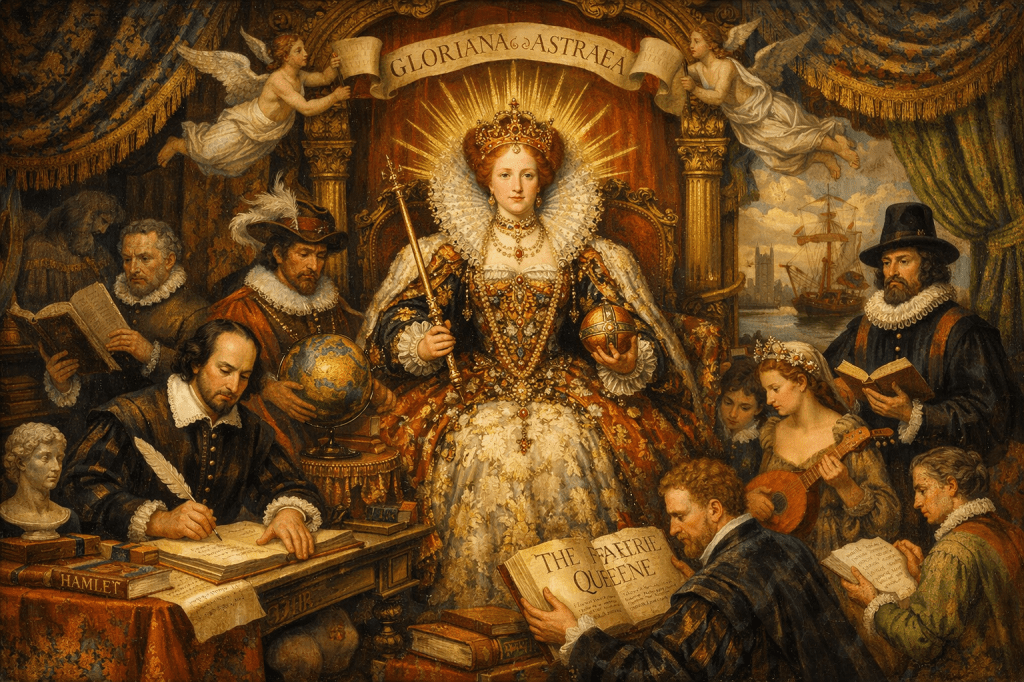
When Elizabeth I comes to power, England finally finds a degree of stability.
Her reign is often seen as the height of the English Renaissance. Politically, she establishes a relatively balanced religious settlement. Culturally, she presides over an extraordinary flowering of literature and the arts.
This is the age of William Shakespeare, Christopher Marlowe, and Edmund Spenser.
Drama becomes the dominant literary form. Public theaters open, and for the first time, literature is not confined to the court or the church. It becomes something people experience together.
Shakespeare’s plays explore ambition, identity, love, and power with a depth that feels timeless. Marlowe’s works push boundaries with bold characters and dramatic intensity. Spenser’s The Faerie Queene blends chivalric romance with political allegory, celebrating Elizabeth while also reflecting on virtue and morality.
This explosion of creativity is not accidental. It is driven by several forces:
- Humanism: A focus on human potential, education, and classical learning.
- Political stability: Writers have more space to create.
- Urban growth: London becomes a cultural center.
- Patronage: Wealthy nobles support artists and writers.
While literature flourishes, everyday life in Tudor England remains deeply structured.
Society is hierarchical:
- Monarch and nobility at the top
- Gentry and merchants in the middle
- Laborers and peasants at the bottom
But this period also sees change.
The dissolution of monasteries redistributes wealth and land. Trade expands, especially with exploration abroad. A growing middle class begins to emerge, particularly in cities like London.
Daily life is shaped by:
- Strong religious influence, even amid conflict
- Seasonal rhythms of agriculture
- Strict social expectations regarding class and gender
Education becomes more accessible, especially for men of the middle and upper classes. Grammar schools expand, and literacy increases. This creates a larger audience for literature.
What Inspired Tudor Literature
Tudor writers are influenced by a mix of old traditions and new ideas.
- Classical antiquity: Greek and Roman texts provide models for philosophy, drama, and poetry.
- Religion: Even as beliefs shift, faith remains a central concern.
- Court life: Power, ambition, and romance dominate much writing.
- Exploration: New discoveries expand the sense of what the world contains.
- Human experience: There is a growing interest in individual thought and emotion.
Perhaps most importantly, there is a sense of possibility. The world feels larger, more uncertain, and full of change.
That energy flows directly into the literature.
The Tudor period does not simply produce great literature. It creates the conditions that make it possible.
It is an age of contradiction. Stability and danger exist side by side. Faith is both central and contested. Power is dazzling and fragile at the same time.
Out of this tension comes a new kind of writing. It is more personal, more ambitious, and more aware of the complexities of human life.
By the time Elizabeth’s reign reaches its height, English literature is no longer finding its voice.
It has found it. And it is speaking loudly.
Next in the Series: Beyond Elizabeth, the Renaissance continues to evolve. New rulers bring new tensions, and literature begins to grapple with deeper questions about authority, identity, and the limits of power.


Leave a Reply