
By the time we reach Geoffrey Chaucer, English literature feels like it has been speaking in distant voices for centuries. Old English poetry carried the weight of heroism and fate. Middle English writing leaned heavily on religion and moral instruction. Much of it feels formal, even a little removed from everyday life.
Then suddenly, everything becomes louder, messier, and far more human.
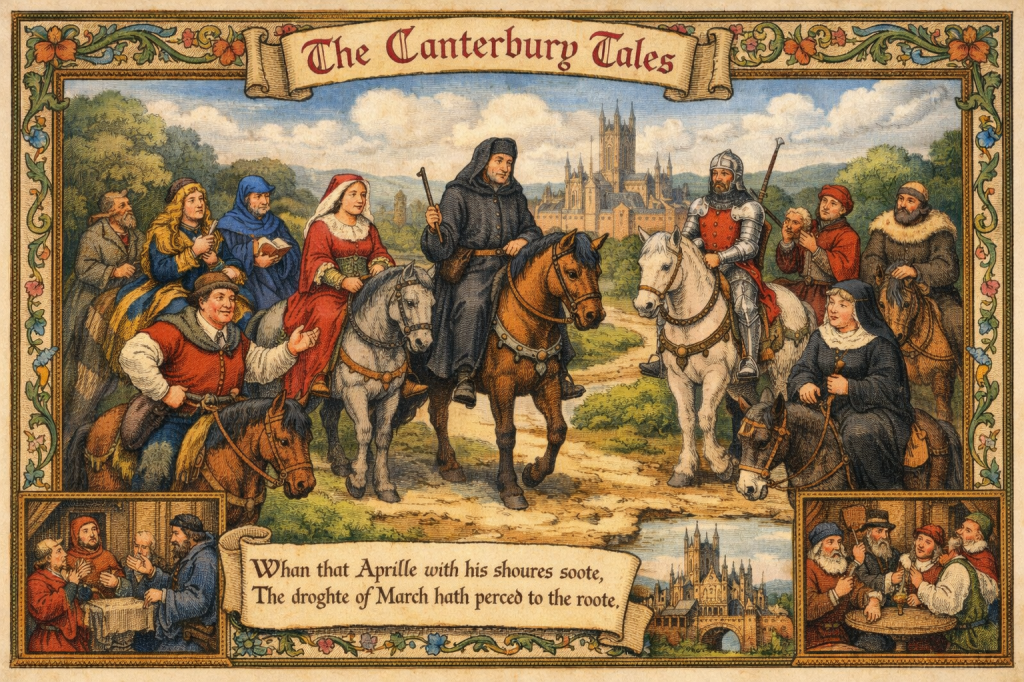
The Canterbury Tales does not quietly continue the tradition. It interrupts it. The premise is simple. A group of pilgrims travels from London to Canterbury to visit the shrine of Thomas Becket. To make the journey more entertaining, they agree to tell stories along the way. The best storyteller wins a free meal at the end.
But the real point is not the contest.
What Chaucer creates is a moving stage where people from completely different walks of life are forced into the same space. A knight rides beside a miller. A prioress shares the road with a merchant. A wife with strong opinions about marriage speaks as confidently as any nobleman.
Instead of a single voice telling us what society looks like, we hear many voices arguing, boasting, joking, and revealing themselves.
Medieval literature often deals in types. The noble knight. The corrupt priest. The humble worker.
Chaucer starts there, but he does not stop there.
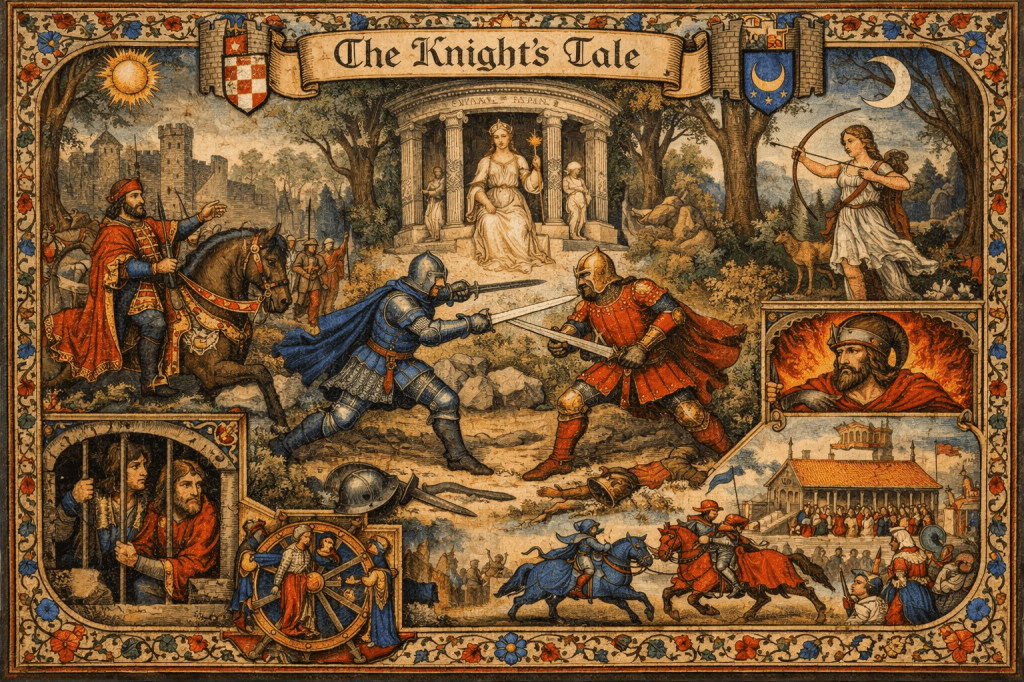
The Knight in the tales represents honor and chivalry, but he is also quiet and modest in a way that feels real. The Miller is crude, loud, and completely uninterested in dignity. The Wife of Bath is perhaps the most striking of all. She speaks openly about marriage, power, and her own experience, refusing to fit into the expectations placed on women of her time.
These characters do not feel like symbols. They feel like people you could argue with, laugh at, or even avoid if you met them on the road.
That shift matters. Literature begins to move closer to real human behavior.
One of Chaucer’s boldest choices is his language.
Before this, much of serious writing in England was in Latin or French. English was widely spoken but not always respected as a literary language.
Chaucer writes in Middle English, the language of ordinary people. He proves that it can carry humor, complexity, irony, and emotional depth. He does not simplify ideas to fit the language. He expands the language to fit the ideas.
It is a turning point. English stops being just a spoken tongue and becomes a literary one.
What makes The Canterbury Tales feel so alive is its refusal to be neat.
Religious figures can be hypocritical, yet religion itself is not dismissed. Love can be noble in one story and ridiculous in the next. Social roles are both reinforced and quietly challenged.
Chaucer does not step in to tell us what to think. He lets the characters expose themselves through their stories and their behavior. Sometimes they contradict each other. Sometimes they contradict themselves.
It feels less like a lesson and more like observation.
Chaucer never finished The Canterbury Tales. He planned for many more stories than he actually wrote.
Strangely, this does not weaken the work.
The interruptions, the incomplete arcs, the sense that more could have been said all add to its realism. The journey feels ongoing, just like life itself. Not every story reaches a perfect ending. Not every voice gets equal time.
And that feels right.
The Canterbury Tales sits at an important moment in literary history.
It still carries elements of the medieval world, with its social hierarchies and moral concerns. At the same time, it begins to move toward something new. There is a growing interest in individuality, in personal voice, in the contradictions within people.
Chaucer does not just describe society. He lets it speak for itself.
And when it does, it turns out to be funny, flawed, sharp, and deeply familiar.
Reading The Canterbury Tales feels less like studying history and more like overhearing a long, chaotic conversation.
People interrupt each other. They exaggerate. They defend themselves. They reveal more than they intend.
Chaucer seems to understand something simple but powerful. If you want to capture a world, you do not stand above it and explain it.
You listen to it.
Next on the Road: The world after Chaucer begins to shift. Old certainties start to loosen, and new ways of thinking slowly emerge. The road leads toward the early Renaissance, where literature begins to ask not just what people should be, but what they are. This is the end of ‘Road to Chaucer’ series. Hop in to my next series where I talk about English literature in the Renaissance period.


Leave a Reply