
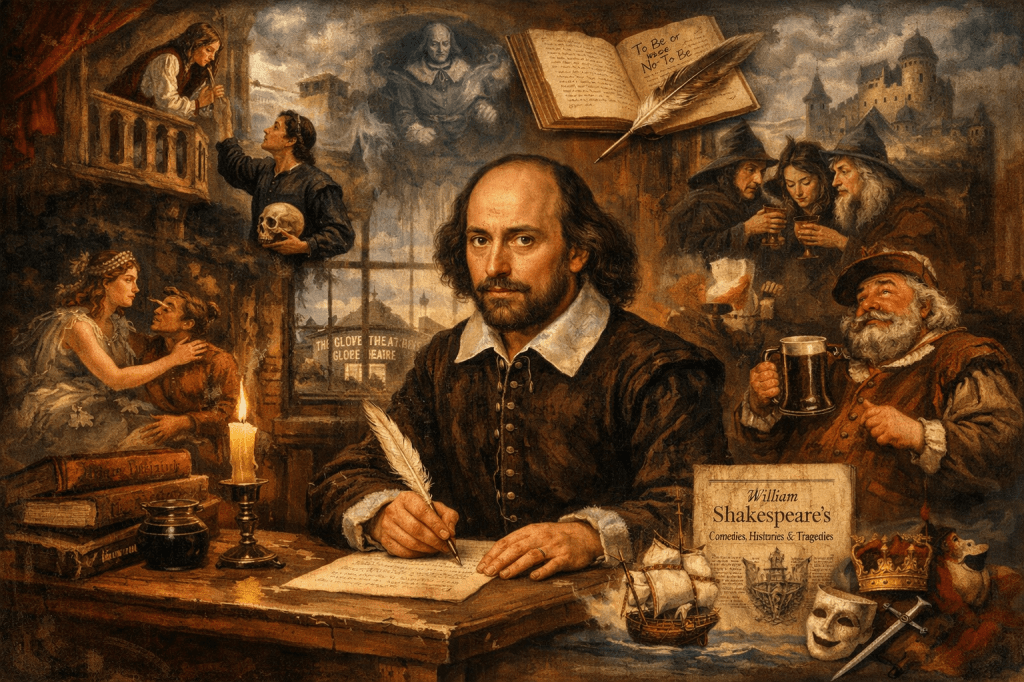
Shakespeare was born in Stratford-upon-Avon, a market town far from the political center of England. His background was not aristocratic, yet he received a solid education grounded in classical texts, which would later influence his writing.
When he moved to London, he entered a city that was rapidly becoming the cultural heart of England. Theaters were thriving. Audiences were diverse. Nobles and commoners alike gathered to watch plays.
Shakespeare became part of the Lord Chamberlain’s Men, later known as the King’s Men. This was not just a writing career. It was a working life in the theater, acting, collaborating, and producing plays for a demanding audience.
Before this period, literature often belonged to the court or the church. Theater changed that.
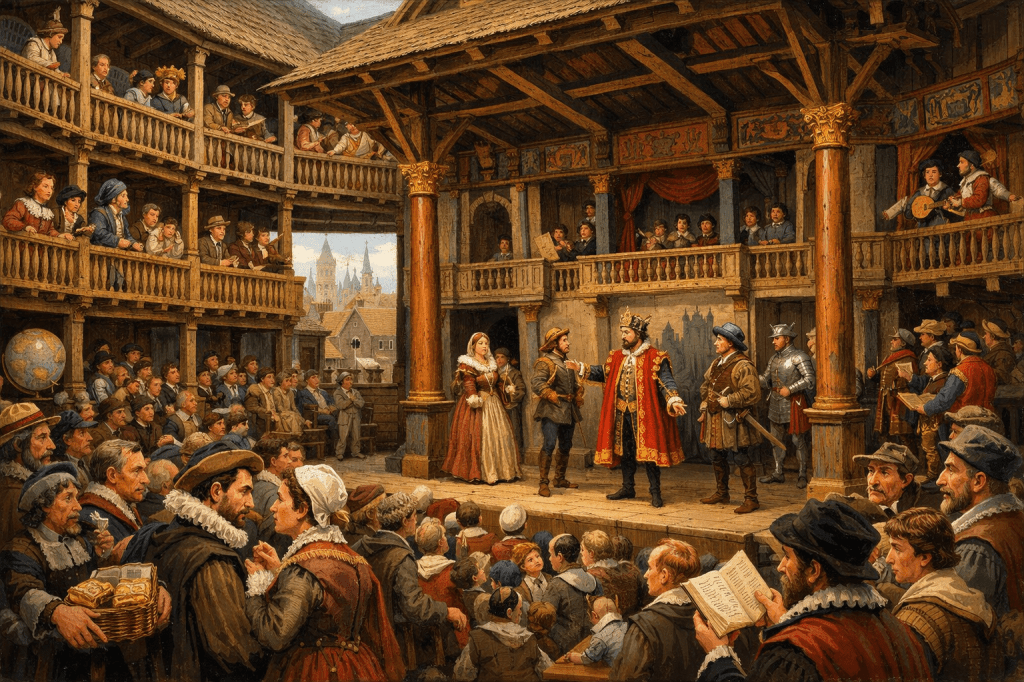
Playhouses like the Globe Theatre created a shared cultural experience. People from different social classes stood side by side, watching the same story unfold.
This shaped how Shakespeare wrote.
- His plays had to entertain a wide audience
- They blended humor with serious themes
- They moved quickly, balancing action with reflection
The result is a form of storytelling that feels immediate and dynamic. It is meant to be heard, seen, and felt all at once.
Shakespeare’s writing is often divided into three main categories: comedies, histories, and tragedies. Each reveals something different about the world he lived in.
Comedies like A Midsummer Night’s Dream and Twelfth Night explore love, confusion, and identity. They often involve disguise, mistaken identity, and playful language. Beneath the humor, they question social roles and expectations.
Histories such as Henry IV and Richard III look back at England’s past, especially the conflicts that shaped the monarchy. These plays reflect ongoing concerns about power, legitimacy, and leadership. They would have resonated strongly with audiences still aware of the Wars of the Roses.
Tragedies like Hamlet, Othello, King Lear, and Macbeth dig into darker aspects of human nature. Ambition, jealousy, betrayal, and madness take center stage. These plays do not offer easy answers. Instead, they expose the fragility of human judgment and the consequences of flawed decisions.
One of Shakespeare’s greatest achievements lies in his use of language.
He writes in a mix of prose and verse, often using iambic pentameter, but never rigidly. His language shifts depending on the character and situation. Kings speak differently from clowns. Lovers speak differently from soldiers.
He also experiments constantly:
- Inventing new words and phrases
- Using metaphor and imagery in unexpected ways
- Playing with rhythm and sound
His writing stretches English, showing how flexible and expressive it can be. Much like Chaucer before him, he proves that English is capable of depth and complexity, but he takes it even further.
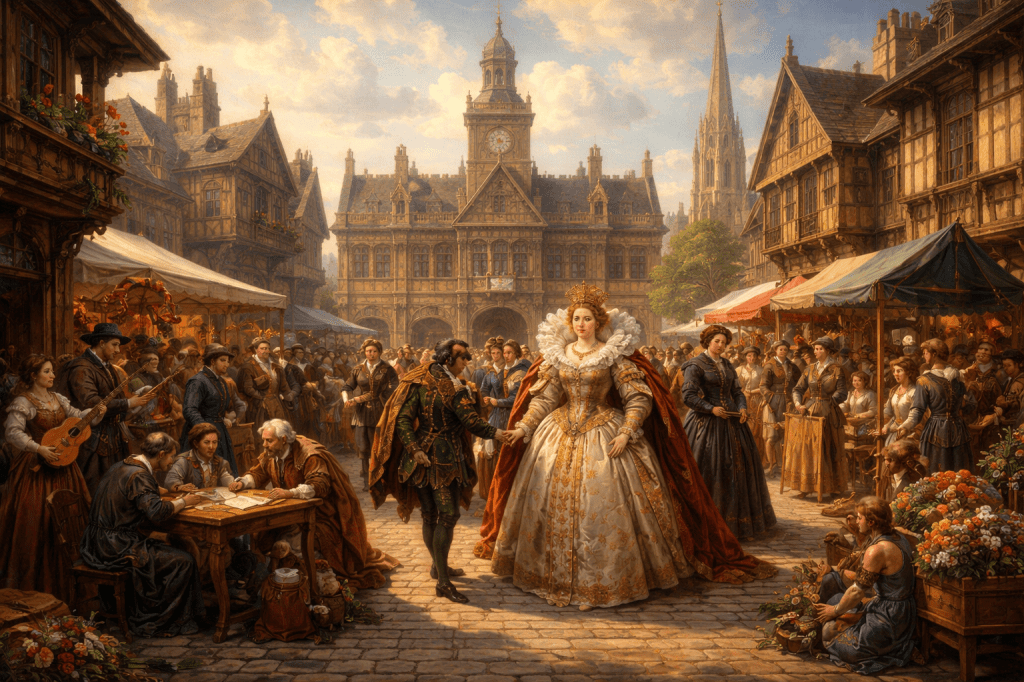
Shakespeare is deeply shaped by Renaissance ideas.
Humanism places value on human experience, emotion, and potential. Classical texts provide models for storytelling, especially from Greek and Roman drama. There is also a growing interest in the inner life of individuals.
All of this appears in his work.
His characters are not just defined by their roles. They think, question, and struggle with themselves. Hamlet hesitates. Macbeth doubts. Lear learns too late.
This focus on internal conflict is one of the reasons his plays still feel modern.
Shakespeare’s plays are not separate from the world around him. They are filled with it.
Elizabethan society was structured but changing. There was a strong sense of hierarchy, yet mobility was becoming possible, especially in cities. Questions about authority, gender roles, and identity were increasingly visible.
His plays reflect these tensions:
- Women challenge expectations, even within limits
- Power is shown as unstable and often dangerous
- Social roles can be performed, questioned, or reversed
At the same time, the plays remain accessible. Humor, wordplay, and spectacle keep audiences engaged, even as deeper themes unfold.
Shakespeare’s work survives not just because it is historically important, but because it continues to feel relevant.
He captures something essential about people:
- The way ambition can blind judgment
- The way love can confuse and transform
- The way power can corrupt
- The way individuals struggle to understand themselves
If the Tudor period created the conditions for cultural growth, Shakespeare represents its fullest expression.
He takes the language, ideas, and tensions of Renaissance England and turns them into stories that feel immediate and alive. His plays are not distant artifacts. They are conversations that continue every time they are performed or read.
In a world that was changing rapidly, Shakespeare found a way to capture both the uncertainty and the possibility of being human.
And that is why he still speaks to us. He is the greatest of all time.


Leave a Reply